
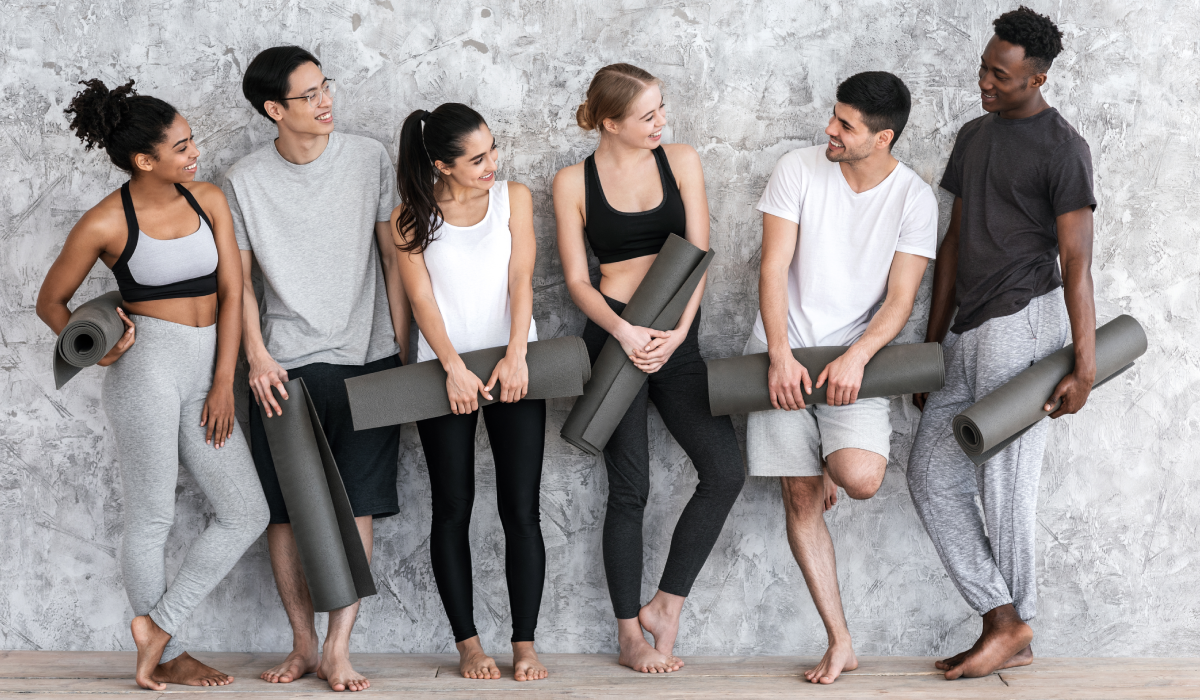
Pilates or yoga? Anyone looking for a workout method to build strength, flexibility, and body awareness will sooner or later face this question. After all, at first glance, both forms of exercise seem remarkably similar: roll out a mat, take off your shoes, and exercise with controlled movements. But appearances can be deceiving.
Pilates and yoga differ both in their origins and in their focus. Pilates focuses particularly on body control, core stability, and precise movement sequences. Yoga, on the other hand, traditionally combines physical exercises with conscious breathing and—depending on the style of yoga—meditative elements. That doesn’t mean, however, that one method is fundamentally better than the other. What matters most is what you hope to achieve with your workout. To answer this question meaningfully, it’s worth first getting to know both forms of exercise separately.
Pilates: Training for a Strong Core
Pilates training traces its origins to Joseph Pilates and evolved in the 20th century into a training method in which controlled movements and a stable core play a central role. The exercises may look unspectacular but can still be extremely challenging. This is because in Pilates, the goal isn’t to complete as many repetitions as possible as quickly as possible. Instead, the focus is on control, precision, breathing, and the quality of movement.
The Core Is Central to Pilates
A hallmark of Pilates is the intensive focus on the core. In this context, the term “powerhouse” is often used. Simply put, this refers to the interaction of various muscle groups around the abdomen, back, and pelvis. These muscles are meant to provide stability during many exercises while the arms and legs are in motion. As a result, Pilates doesn’t just train the superficially visible abdominal muscles. Rather, the focus is on performing movements from a controlled and stable position. People who spend a lot of time sitting in their daily lives often find this conscious focus on posture and movement to be a pleasant contrast to sitting at a desk.
Pilates and the Back
Another reason for Pilates’ popularity is its strong focus on the core and movement control. Consequently, Pilates is frequently offered as a workout for the back. There is indeed scientific evidence to support this. Systematic reviews have concluded that Pilates can reduce pain and functional limitations in people with chronic nonspecific back pain. While Pilates is not a miracle cure for back pain, it can be a useful way to combine movement, core training, and body control.
Mat Pilates or Reformer Pilates?
Pilates is now popular primarily in two forms. Mat Pilates primarily uses your own body weight for exercise. Small props such as a Pilates ball, ring, or resistance bands can provide additional training stimuli. Reformer Pilates uses a specialized piece of equipment. A sliding carriage, along with springs, cable pulleys, and various adjustment options, allows for numerous exercises and different levels of resistance. However, this doesn’t automatically make Reformer Pilates more effective, as both forms can be very challenging.
Yoga: Movement Meets Breathing and Relaxation
Yoga has much older roots than Pilates and originated from traditions of Indian philosophy. The forms practiced in gyms today often focus on three areas: postures, breathing, and relaxation or meditation. However, the emphasis placed on these individual elements depends significantly on the specific style of yoga. That’s why the statement “Yoga is relaxing” is just as incomplete as the claim “Yoga is just stretching.” An intense Vinyasa class can be extremely physically demanding. A calm Yin Yoga session, on the other hand, pursues a completely different goal.
Yoga Can Improve Flexibility
Many forms of yoga regularly place the body in different positions and ranges of motion. Flexibility therefore plays an important role in numerous exercises. However, this leads to a common misconception: You don’t have to be flexible to start practicing yoga. Flexibility is not a prerequisite for your first yoga class. Good instructors adapt exercises to each person’s individual range of motion and offer different variations. And the goal is by no means to master the most spectacular poses. For everyday life, it can be far more valuable to be able to move safely and with control within a range of motion that’s appropriate for you.
Yoga as a Balance to a Stressful Daily Life
A distinctive feature of yoga is the conscious connection between movement and breathing. Depending on the style, elements of relaxation and meditation are also incorporated. This sets yoga apart from many traditional fitness programs. Scientific studies suggest that yoga can support stress management, mental well-being, and sleep, among other benefits. For people who, after a hectic workday, want not only to be physically active but also to consciously wind down, calmer forms of yoga can therefore be particularly appealing.
Which yoga style is right for whom?
If you’d like to try yoga, don’t just search for “yoga.” The specific style can make a significant difference.
Hatha Yoga is often taught at a slower pace. Individual poses are held longer, giving beginners more time to become familiar with the movements.
Vinyasa yoga combines different poses into flowing sequences of movement. This can make the practice significantly more dynamic and physically demanding.
Yin Yoga is much more relaxed. Poses are often held for longer periods, which is why this style is often used as a counterbalance to more intense workouts or a hectic daily routine.
However, the terminology isn’t fully standardized. Two classes with the same name may therefore differ considerably.
Pilates vs. Yoga: What Is the Main Difference?
Pilates places a particularly strong emphasis on core stability, controlled movements, and body control. Yoga connects postures more closely with breathing, flexibility, and—depending on the style—relaxation and meditation. Of course, there are overlaps. Pilates also incorporates conscious breathing. Yoga can also intensively challenge the core. And both forms of exercise can build strength, coordination, and body awareness. The differences therefore lie less in a strict “yoga does X, Pilates does Y” distinction and more in the specific areas each training method emphasizes.
Pilates or Yoga: Which Is Better for Which Goal?
This is exactly where the comparison becomes interesting in practice. After all, whether Pilates or yoga is a better fit for you depends primarily on what you want to achieve.
Which is better for your back?
Both forms of exercise are generally suitable. Due to its strong focus on core stability and movement control, Pilates has an obvious connection to back training. Studies show positive effects for chronic nonspecific back pain. There is also scientific evidence supporting yoga’s benefits. If your main goal is to specifically train core stability and controlled movement, you’ll likely find Pilates particularly appealing. If you want to combine back exercises with flexibility, breathing, and relaxation, you might prefer yoga.
Which is better for building muscle?
If “muscle building” refers to maximizing muscle mass, the answer is a bit more complicated: Neither classical Pilates nor yoga is primarily designed for maximum muscle hypertrophy. Pilates can still provide an intense workout for the muscles, especially in the core. On the Reformer, resistance can also be applied. Yoga can also be surprisingly strength-intensive. Poses such as planks, Chaturanga, or prolonged standing poses engage numerous muscle groups. Those who specifically want to build as much muscle mass as possible are usually better off with progressive strength training. However, yoga and Pilates can be excellent complements to such a training regimen.
Which is better for flexibility?
If flexibility is your primary goal, yoga is the more obvious choice due to its typical training focus. Many forms of yoga regularly incorporate a range of motion and poses held for longer periods. Pilates also trains flexibility, but often combines it more strongly with stability and controlled movement. So if your primary goal is to become more flexible, you can start with yoga. If you’d like to combine flexibility more closely with core stability and movement control, Pilates offers an interesting alternative.
Which is better for beginners?
Both are suitable for beginners. More important than choosing between Pilates and yoga is choosing the right class. A challenging Vinyasa class can be just as overwhelming for a yoga novice as an advanced Pilates class. A well-structured beginner’s or introductory class, on the other hand, teaches the most important movements step by step. In Pilates, it’s especially important to learn the basics of breathing, body positioning, and core engagement correctly. In yoga, beginners should make sure that different variations are offered and that they don’t try to force themselves into poses. So when starting out, the key is this: it’s not that yoga or Pilates has to be beginner-friendly—it’s that the specific class has to be.
Which is better for relaxation?
Here, yoga has a clearer focus. Calmer forms of yoga, in particular, combine slow movement with conscious breathing, held poses, and sometimes meditation. Pilates can also require concentration and be experienced as a form of mental balance. In classical Pilates, however, relaxation is less central to the training concept. Anyone specifically looking for a combination of physical movement and mental relaxation should therefore try gentler forms of yoga in particular.
Which is better for weight loss?
If you want to lose weight, you shouldn’t base your decision on which method supposedly burns the most calories. In the long term, energy balance is the key to weight loss. How much energy is expended during yoga or Pilates depends on numerous factors—including workout duration, intensity, yoga style, body weight, and individual fitness level. A dynamic yoga class differs significantly from a gentle Yin session. The same applies to different Pilates workouts. In practice, therefore, another question is often more important: Which form of exercise do you enjoy so much that you’ll do it regularly?
Combining Pilates and Yoga: Why You Don’t Have to Choose
When asking “Pilates or yoga?”, people often overlook the fact that the two methods don’t have to be competitors. On the contrary: their different focuses can complement each other perfectly. Pilates can specifically target core stability and movement control. Depending on the style, yoga brings additional elements of flexibility, balance, breathing, and relaxation to your workout.
For example, someone who does strength training regularly could incorporate an additional Pilates session for core strength and body control and, on another day, include a gentle yoga session as a dynamic balance.
But even without a gym, you can combine the two. Two workouts per week don’t necessarily have to involve the same method twice.
Here’s how to find out what really works for you
A useful practical test is surprisingly simple: Attend several suitable beginner classes and then don’t just focus on how strenuous the workout was. Pay attention to how you feel during and after the session. Do you enjoy the precise, controlled movements of Pilates? Or does the combination of movement, breathing, and stillness in yoga appeal to you more?
Even more important is whether you feel like coming back. Because in the long run, this factor matters far more than minor theoretical differences between the two training methods.
FAQ: Frequently Asked Questions About Pilates and Yoga
What’s the biggest difference between yoga and Pilates?
Pilates focuses particularly on core stability, body control, and precise movements. Yoga connects physical postures more closely with breathing and—depending on the style of yoga—flexibility, relaxation, and meditation.
Which is more strenuous: yoga or Pilates?
That depends on the specific workout. Both Pilates and yoga can be very intense. A dynamic Vinyasa flow, for example, can be significantly more strenuous than a gentle yoga session. Intensity and difficulty levels also vary considerably within Pilates.
Is Pilates or yoga better for the back?
Both forms of exercise can be beneficial. Pilates places a special emphasis on core stability and movement control. Yoga can also incorporate flexibility and relaxation. If you have existing back issues, the type of exercise should be tailored to your individual situation.
Which is better for a flat stomach: yoga or Pilates?
Pilates specifically targets the core muscles but cannot specifically reduce body fat in the abdominal area. You cannot control where the body loses fat through specific exercises. In the long term, energy balance is the most important factor for reducing body fat percentage.
Can you build muscle with Pilates?
Pilates can strengthen the muscles and specifically challenge the core muscles. For maximum muscle growth, progressive strength training with appropriate resistance is generally more effective.
Is yoga or Pilates better for weight loss?
Neither form of exercise is inherently better for weight loss. Energy expenditure depends on intensity, duration, and individual factors. For long-term weight loss, energy balance, nutrition, and regular exercise play a more significant role.
Do you have to be flexible to do yoga?
No. Flexibility is not a prerequisite for yoga. Exercises can be adapted to an individual’s range of motion. A good beginner’s class offers appropriate variations.
How often should you do Pilates or yoga?
There’s no one-size-fits-all optimal frequency. The key factors are your fitness goals, intensity, other physical activities, and recovery. For beginners, a realistic, sustainable routine is more important than maximizing the number of sessions.
Can you combine yoga and Pilates?
Yes. The two forms of exercise complement each other well. Pilates can place a stronger focus on core stability and movement control, while yoga can add flexibility, balance, breathing, and relaxation to your workout.
Editorial team at fitnessmarkt.de
Image source: #1601369819 Prostock-studio / stock.adobe.com
Published on: 13 October 2026