
What should fitness equipment look like as space becomes scarcer, training concepts become more diverse, and members increasingly expect digital offerings? BH Fitness answers these questions with several new products. It’s not just about new equipment, but also about different approaches to the training space of tomorrow.
Anyone planning or modernizing a fitness facility today must consider more than just the sheer number of machines. Strength training, functional training areas, cardio, group training, and open training spaces all compete for floor space. At the same time, members expect a variety of training options—from classic strength training to connected workouts.
This also presents new challenges for equipment manufacturers. Machines must be robust and suitable for professional use, while at the same time making the most efficient use of available space. Added to this are digital interfaces and increasing demands for usability and safety.
BH Fitness addresses several of these developments with its latest product expansions. This is particularly evident in a new plate-loaded series designed to solve a familiar problem: What do you do when professional strength training is desired, but there simply isn’t enough space for a large line of machines?
PLR Studio: Plate-Loaded in a Smaller Space
Plate-loaded machines have a firm place in many strength training areas. They combine guided movement patterns with weight loading via weight plates, appealing to both experienced strength athletes and members who prefer machines over free weights. However, complete plate-loaded lines require space.
With PLR Studio, BH Fitness is therefore taking a more compact approach. The new series was designed for facilities that want to integrate a professional plate-loaded area without having to dedicate a large portion of their training space to it. This makes the concept particularly appealing—in addition to traditional gyms—for boutique studios, personal training spaces, hotels, or smaller training rooms.
Instead of offering as many specialized exercises as possible, the series focuses on fundamental movement patterns. In total, PLR Studio comprises nine machines: Leg Extender PLR010, Lying Leg Curler PLR030, Chest Press PLR070, Shoulder Press PLR090, Lat Pulldown PLR110, Biceps Curl PLR130, Triceps/Biceps Curl PLR140, Seated Calf Raise PLR210, and Seated Rowing PLR300.
This manageable selection is part of the concept. Upper-body pulling and pushing movements, as well as essential exercises for the leg muscles, can be covered by this line without having to set up multiple variations for each muscle group.
What’s particularly interesting is the approach behind the equipment. When designing training areas, the mindset is often still focused on having the largest possible fleet of machines. For smaller facilities, however, the opposite question may make more sense: How few machines are needed to cover as many relevant training needs as possible?
This changes the way space is planned. Especially in boutique, hotel, or personal training concepts, a deliberately limited selection of strength training equipment can create space for free-form exercises, functional training, or other offerings. PLR Studio aims for precisely this middle ground: a professional plate-loaded zone without the space requirements of a comprehensive traditional lineup.
Indoor Cycling: Between Group Classes and Digital One-on-One Training
Another trend is emerging in indoor cycling. Here, it is not so much the mechanics of the bike as the digitalization that is transforming the user experience.
Training apps, virtual routes, and performance data have long since taken indoor cycling beyond the traditional class room. At the same time, group training with an instructor and fellow participants remains an important part of the class offerings for many studios. BH Fitness takes both scenarios into account in the redesign of a well-known model.
The Duke H925 has been part of BH Fitness’s indoor cycling portfolio for years. Now, the bike has undergone a comprehensive redesign. In addition to its new black finish, several components have also been updated.
For operators, however, one innovation in particular is likely to be relevant: the bike is offered with two different monitor options. With this, BH is making a conscious distinction between individual, digitally connected training and use in group classes.
FTMS for individual training:
The H925R1FTMS features an FTMS-compatible monitor. FTMS stands for Fitness Machine Service and enables communication via Bluetooth between the fitness machine and compatible apps. This allows training data to be transferred to corresponding apps. With the new Duke, this opens up the possibility, among other things, of integrating platforms like Zwift or Kinomap into individual indoor cycling training.
For customers, this can result in a significantly different training experience. Instead of merely tracking time, resistance, and power on the bike, the device becomes part of a digital training environment featuring virtual routes and interactive sessions.
For gym operators, it’s worth noting that this doesn’t necessarily require the gym to have a separate digital training system. Members can incorporate compatible apps into their individual workouts.
A separate version for group classes:
The H925R1BT takes a different approach. Its Bluetooth connectivity is designed for use in group classes and can be combined with platforms such as Telegym or Spivi.
In doing so, BH Fitness acknowledges an important distinction: A bike for individual training does not necessarily have to meet the same digital requirements as a machine in a cycling studio with 20 or 30 participants.
The two monitor options allow operators to better tailor the technical equipment to the actual usage scenario.
When the ceiling becomes a factor with the stair climber
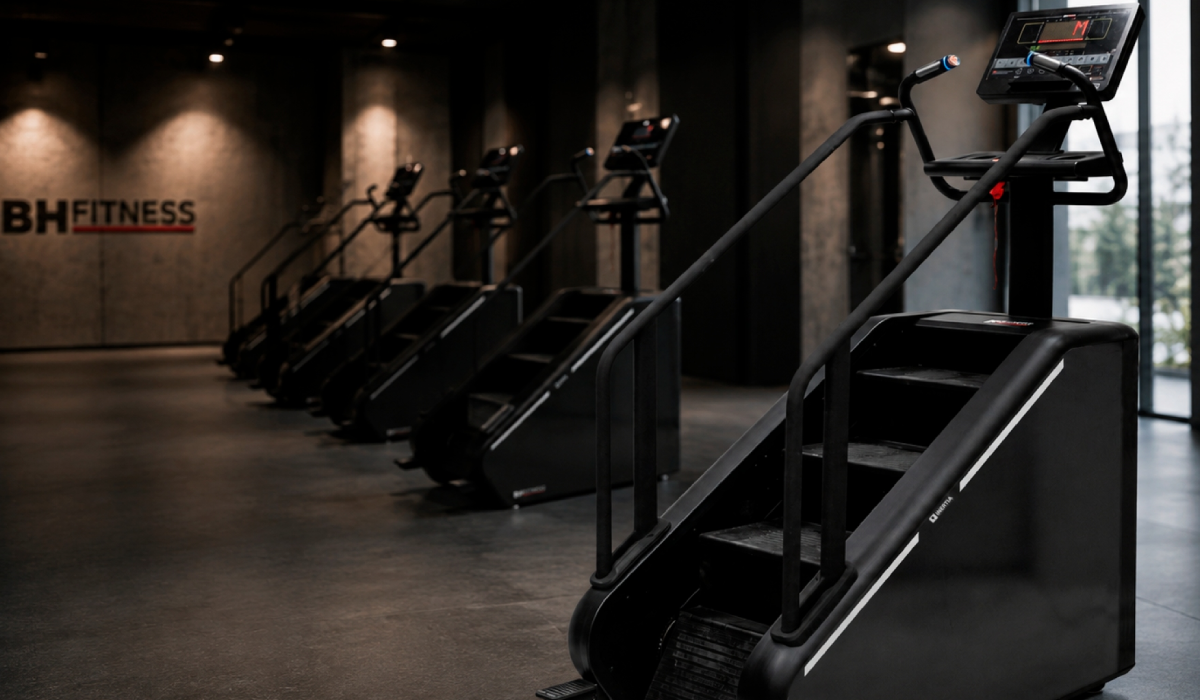
Even in cardio training, it’s clear that product development doesn’t always have to mean inventing entirely new forms of exercise. Sometimes it’s about a very practical problem. Stair climbers are very popular in cardio areas, but they present operators with a unique challenge when planning the space: The user moves on the machine well above floor level. Accordingly, not only the machine’s height but also the available ceiling height must be taken into account.
With the new SC700 from the INERTIA family, BH Fitness is targeting, among others, facilities where precisely this height is a limiting factor. According to the manufacturer, the stair climber is designed for gyms, clubs, hotels, and other training facilities and is engineered for a ceiling height of 280 centimeters.
This brings to the forefront an aspect that is easily overlooked when selecting equipment: a cardio machine must not only fit the floor plan but also be compatible with the structural conditions of the location.
The SC700 also features an automatic safety stop. This function can be particularly relevant for facilities where specific safety requirements must be met—for example, as part of certain bids or operational guidelines. This means that safety is not merely a feature but a potential deciding factor in equipment procurement.
Functional training remains part of the overall concept
In addition to the major new machine innovations, BH Fitness is also expanding its line of accessories. New additions to the lineup include bumper plates in five weight classes and kettlebells ranging from 8 to 24 kilograms.
The bumper plates are color-coded by weight: 5 kilograms in black, 10 kilograms in green, 15 kilograms in yellow, 20 kilograms in blue, and 25 kilograms in red. The kettlebells are available in 8, 12, 16, 20, and 24 kilograms.
At first glance, new weight plates and kettlebells may seem less spectacular than a new line of machines. Nevertheless, they are essential for planning modern training spaces, since traditional machine training, free weights, and functional training have long since ceased to exist as separate worlds in many gyms.
A workout can start on the chest press, continue with free-weight exercises, and end with kettlebell carries or other functional movements. This makes equipment that allows for combining different forms of training all the more important.
The square meter becomes the planning unit
When looking at these innovations as a whole, a common theme stands out: fitness equipment is increasingly being conceived within the context of the entire training space.
At PLR Studio, the focus is on how to implement a plate-loaded system with a smaller footprint. With the Duke, the focus is on how an indoor bike must meet different digital requirements depending on its intended use. With the SC700, ceiling height and safety become key planning parameters. The accessories, in turn, complement the classic machines by offering free-weight and functional training options.
For gym operators, this leads to a fundamental consideration: It is not necessarily the facility with the most equipment that offers its members the greatest variety of workouts. What matters most is how effectively equipment, open training space, digital offerings, and different training methods work together.
This question is likely to become even more important in the future, particularly for smaller gyms, boutique concepts, and hotel facilities. In these settings, every additional square meter of training space is valuable, and every piece of equipment must justify its place accordingly.
For operators, the challenge is therefore increasingly not to cram as much equipment as possible into a given space, but to find the right equipment for their own training concept.
Editorial team at fitnessmarkt.de
Source and image source: BH Germany GmbH
Published on: 21 September 2026