
When do you need to go to bed to wake up feeling rested? Instead of strictly focusing on eight hours, our sleep needs calculator works backward from your wake-up time—in full sleep cycles, tailored to your chronotype and exercise routine.
How much sleep do you really need?
For adults, seven to nine hours is considered a general guideline. Those who train regularly and intensively tend to fall toward the upper end of this range: During sleep, repair processes take place in the muscles, the nervous system recovers, and training stimuli are translated into adaptations.
Conversely, too little sleep quickly shows up in your training—as poorer coordination, reduced strength endurance, a higher risk of injury, and a significantly increased appetite. Sleep is therefore not an afterthought, but an integral part of your training. You can read more about this in our article on recovery after exercise.
Why Cycles Make More Sense Than Hours
Sleep occurs in cycles that last about 90 minutes on average. Each cycle progresses from light sleep through deep sleep into the REM phase and back again.
If you wake up at the end of a cycle, getting out of bed usually feels easy. If your alarm clock rouses you from deep sleep, you’ll feel exhausted even after eight hours. That’s exactly why our calculator uses whole cycles rather than round hours.
| Cycles | Sleep Duration | For whom |
| 4 cycles | 6.0 hours | Emergency solution, not for long-term use |
| 5 cycles | 7.5 hours | Standard for most adults |
| 6 cycles | 9.0 hours | Intensive training, competition phases, strength building |
| 7 cycles | 10.5 hours | Recovery after intense training blocks or lack of sleep |
Here’s how the calculator works
It starts with your wake-up time and counts backward: the desired number of 90-minute cycles plus the time it takes you to fall asleep. Typically, this is 10 to 20 minutes.
Here’s an example: You get up at 6:30 a.m. and need 15 minutes to fall asleep. For five cycles, you should be in bed by 10:45 p.m.; for six cycles, by 9:15 p.m.
Your training load affects the recommendation: For intense training, the calculator suggests six cycles; otherwise, five to six.
Chronotype: Lark, Owl, or Something in Between
Your chronotype describes when your body naturally becomes tired and wakes up again. It is largely genetically determined and cannot simply be “trained away.”
Early birds get tired early in the evening and are quickly at their best in the morning. For them, an early workout is no problem.
Night owls are at their best in the evening and struggle to get out of bed in the morning. If you’re a night owl who has to get up at 5:30 a.m., you’ll accumulate a sleep deficit during the week—what’s known as “social jet lag.”
The calculator takes this into account in the note below the result: For night owls, it makes more sense to push back their wake-up time—if their daily routine allows it—rather than shortening their sleep duration.
Exercise and Sleep
Exercise improves sleep quality—with one caveat: Very intense workouts right before bedtime keep your heart rate and core body temperature elevated. If possible, allow two to three hours between a strenuous workout and bedtime. Light workouts in the evening, on the other hand, are not a problem.
For gyms, late evening is still an important time slot: Many members don’t arrive until after work. Classes with a gentle cool-down, mobility exercises, and the sauna are a better fit here than a HIIT session at 9 p.m. The training heart rate calculator shows you just how intense your workout actually was.
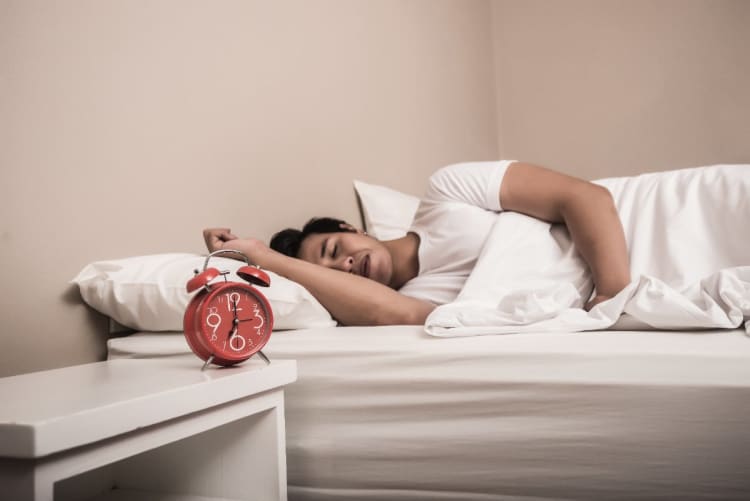
What measurably improves sleep
Consistent sleep schedules are the most effective strategy: If you go to bed and wake up at roughly the same time every day, you’ll fall asleep faster and wake up feeling more refreshed—even on weekends.
Add to that a dark, cool bedroom at about 16 to 19 degrees, natural light in the morning, caffeine only up to about eight hours before bedtime, and no alcohol as a sleep aid. Alcohol shortens the time it takes to fall asleep but disrupts deep sleep in the second half of the night.
What the calculator can’t do
It assumes an average cycle duration of 90 minutes. In reality, this varies from person to person between 80 and 110 minutes and even changes throughout the night. So the calculated times are a good starting point, not a minute-by-minute schedule.
If you’ve been sleeping poorly for weeks, feel exhausted in the morning despite spending enough time in bed, or snore noticeably and experience breathing pauses at night, you should see a doctor. A calculator is no substitute for a sleep lab evaluation.
Frequently Asked Questions / FAQ
Is six hours of sleep enough?
Not in the long term for the vast majority of people. Four cycles can get you through a short period, but over the course of weeks, performance, concentration, and immune function decline measurably.
Can I catch up on sleep on the weekend?
To some extent. Sleeping one to two hours longer can make up for a small deficit. However, if you wake up three hours later on the weekend, you shift your rhythm so much that Monday becomes all the more difficult.
Is an afternoon nap a good idea?
Yes, if it’s short. Twenty to thirty minutes in the early afternoon refreshes you without disrupting your nighttime sleep. Longer naps often lead to deep sleep and leave you feeling sluggish afterward.
Why do I keep waking up at night?
Short periods of wakefulness between sleep cycles are normal; usually, you don’t even remember them. It becomes a problem when you lie awake for longer periods. In that case, sticking to a regular schedule, drinking less alcohol in the evening, and keeping your bedroom cool can help.
Do athletes really need more sleep?
During periods of intense training, yes. Many competitive athletes sleep nine hours or more because their recovery otherwise can’t keep up with the volume of their training.
Editorial team at fitnessmarkt.de
Image source: #1503138 jcomp / freepik.com
Published on: 14 August 2026