
For a long time, gyms were primarily one thing: functional spaces. Equipment had to be sturdy, space had to be used efficiently, and workout routines had to run as smoothly as possible. That’s still important. But it’s no longer enough, because our expectations for the places where we spend our time have changed. We work in modern office environments, drink coffee in carefully curated cafés, stay in hotels where the interior design is part of the brand experience, and increasingly expect more from a gym than just a collection of good exercise machines. The equipment room is becoming an experience space.
Architecture, lighting, materials, acoustics, and digital technologies now help shape how we perceive our workouts. Even the fitness equipment itself has become an integral part of the interior design. The extent to which this concept has taken hold is demonstrated, among other things, by the Onyx premium cardio collection from Matrix Fitness: rather than treating technology and aesthetics as separate entities, it combines training functionality with a deliberately minimalist, high-quality design language.
When Training Becomes a Lifestyle
But why has design become so important for gyms in the first place? The answer begins outside the gym. For many people, fitness is no longer limited to two or three hours of training per week. Smartwatches count steps and analyze activities, apps guide workouts, and recovery and sleep are taking center stage. Exercise, nutrition, and well-being are increasingly merging into a single lifestyle.
This, in turn, is changing expectations for the spaces where people work out. A modern fitness facility no longer competes solely with the gym next door. Its design is—consciously or unconsciously—compared to boutique hotels, spas, modern offices, concept stores, or high-end dining concepts. At first glance, this may seem superficial. After all, in a gym, the workout should be what matters most.
But good design is more than just decoration. It can provide orientation, delineate different areas, create an atmosphere, and give a place an identity. Above all, however, it can influence whether we enjoy spending time somewhere. And that is precisely what is becoming increasingly relevant for fitness providers.
Gym design doesn’t start with the wall color
When planning a fitness facility, people quickly think of colors, flooring, and lighting. Good gym design, however, begins earlier: with the question of how people should experience the space. What do members see when they enter the training area? Where does natural light enter? Which areas feel open, and which feel more secluded? Are the pathways intuitive? Does a harmonious overall picture emerge between the individual training zones? This also changes the traditional approach to space planning.
In the past, the central question was often: How many pieces of equipment can be sensibly accommodated within the available space? Today, a second question has been added: How can this be transformed into a space where people actually want to work out? This shift in perspective is particularly evident in high-end fitness clubs, hotels, and wellness facilities. There, the training area does not stand in isolation from the lobby, spa, and dining areas. It becomes part of an overarching design concept.
Matrix applies this approach, for example, when planning fitness and wellness areas for the hospitality industry. Lighting, clear wayfinding, different training zones, materials, and acoustics are all considered elements of a holistic spatial experience.
Fitness equipment becomes part of the architecture
This brings into focus an element that, for a long time, was viewed primarily from a functional perspective in interior design concepts: the exercise equipment itself. Fitness equipment is among the largest and most conspicuous objects in a gym. You can’t hide a treadmill behind a houseplant. A row of cardio machines inevitably shapes the feel of a room. So why shouldn’t their design play a role in interior architecture?
This is precisely where an interesting development in the industry is emerging. Manufacturers are increasingly focusing not only on ergonomics, durability, and workout data, but also on design language, finishes, lighting, and digital user guidance.
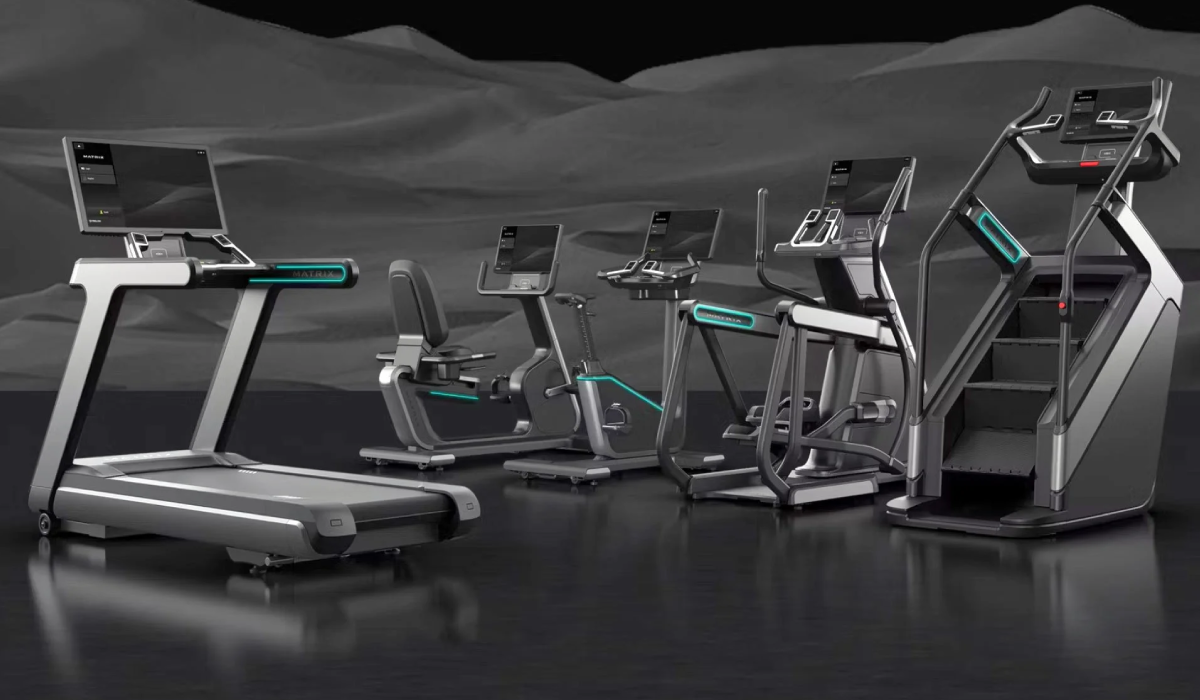
One example of this is the Onyx Collection from Matrix Fitness. This premium cardio collection includes a treadmill, Ascent Trainer, ClimbMill, as well as upright and recumbent bikes. Matrix combines clean lines with high-quality finishes, textured elements, and strategically placed lighting accents. The equipment is not meant to simply stand side by side, but to create a cohesive visual ensemble.
What’s interesting here isn’t so much a specific material or design detail. Rather, it’s the shift in perspective behind it: the exercise machine transforms from a mere piece of equipment into an element of interior design.
Matrix Onyx: Where Function and Aesthetics Converge
Anyone looking at the Onyx machines will recognize many design ideas familiar from other premium segments. Surfaces are not selected solely based on their durability, but also on their visual impact. Lighting serves not only to improve visibility but is also used as an accent. Displays are not simply aftermarket information panels but an integral part of the overall design.
With Onyx, for example, Matrix integrates subtle lighting elements directly into the device design. Added to this are large touchscreens and haptic controls. The goal is for technology, materials, and form to interlock as naturally as possible.
Behind this lies a principle that has long been familiar in the automotive industry and consumer electronics. When it comes to a high-quality car, we’re not just interested in horsepower and fuel economy. With a smartphone, it’s not just the processor and memory that determine how we perceive it. Materials, usability, lighting, haptics, and design shape the product experience just as much—if not more. Fitness equipment is increasingly moving in the same direction.
Light changes how we experience a workout
The connection between architecture and fitness becomes particularly clear when it comes to lighting. Light can make a space appear larger or smaller, help with orientation, and visually separate different areas from one another. Warm, indirect light creates a completely different atmosphere than a uniformly lit training hall.
This doesn’t mean that a gym has to be as dark and spectacularly staged as possible. Rather, what matters is that the lighting concept aligns with the gym’s positioning. A performance-oriented training club may require a different atmosphere than a wellness hotel. A boutique studio can feel more intimate than a large-scale fitness center.
It’s interesting to note that lighting has now even become part of the equipment itself. At Onyx, for example, Matrix uses integrated lighting accents to highlight the contours and surfaces of the machines. This adds an extra layer to the interior design: it’s not just the ceiling, walls, and floor that determine the lighting ambiance—the exercise equipment itself can contribute to it as well.
Technology Doesn’t Have to Look Like Technology
The same applies to digitalization. Touchscreens, apps, entertainment options, and connected training systems are now part of everyday life in many studios. But as digitalization advances, expectations are changing. The question is no longer just: What can the technology do? But rather: How intuitively can it be used?
We often barely even notice the best digital experiences as such. A smartphone doesn’t explain its technology every time you touch it. In a modern car, numerous functions are hidden behind a clear user interface. Good technology fades into the background until it’s needed.
This form of intuitive operation is also becoming more important for fitness equipment. The Onyx cardio machines feature large, high-resolution 22-inch touchscreens. These are complemented by controls with haptic feedback. The digital interface thus becomes not only a source of information but an integral part of the overall product experience. For modern fitness centers, this is a key consideration: technology should support the workout, not come between the user and the workout.
The Fitness Room as a Calling Card
This shift is particularly evident in the hotel industry. Just a few years ago, the fitness room in many hotels seemed almost like an afterthought: a secluded room, a few cardio machines, a mirror, and a TV. The main thing was to be able to check off “fitness area” on the list of amenities. That’s changing.
For many hotels, wellness and fitness are becoming key components of their offerings. As a result, the demands on design are also growing. A fitness area in a high-end hotel must speak the same design language as the lobby, guest rooms, restaurant, and spa.
An example from London illustrates just how relevant this can be. At the Four Seasons Hotel London at Tower Bridge, Matrix’s Onyx Collection was integrated into the modernized fitness area. According to the hotel management, the visual harmony between the equipment and the space also played a role in the selection process. After the renovation, guests reportedly even specifically cited the fitness area as a reason for booking again. This is an interesting detail, as it shows just how much the role of the fitness area has changed. It is evolving from a supplementary offering into an integral part of the brand experience.
Fewer Machines, More Space?
The trend toward creating an experiential space raises another question: Does a good gym have to offer as many machines as possible? Not necessarily. Smaller spaces, in particular, can benefit from not being filled to the last square meter. Clear pathways, thoughtfully designed sightlines, and sufficient space to move can create a higher-quality impression than a maximum density of equipment.
This by no means implies sacrificing training variety. It means planning spaces more thoughtfully. Different floor coverings can define training zones. Lighting can visually structure areas. Mirrors can open up spaces, while materials and colors create a sense of cohesion. And a consistent design language for the equipment can create visual calm. The key question thus shifts. It’s no longer just: “What else can fit in here?” But rather: “What does this space need so that people enjoy working out here?”
Can good design even influence motivation to train?
This is where it gets particularly interesting. Of course, a beautiful gym is no substitute for a good workout plan or qualified guidance. And a designer treadmill doesn’t automatically turn someone who hates working out into a marathon runner. But spaces influence our behavior. We like to stay where we feel comfortable. We perceive quality through numerous small cues. And we associate places with specific emotions and experiences.
For fitness studios, design can therefore be more than just an aesthetic investment. It can become part of the customer experience—from the moment someone first steps into the studio to the actual workout. Especially in a market where many providers are becoming increasingly similar in terms of technology, this can make a difference. After all, members may not remember what color the walls were or what material was used on a piece of equipment. But they certainly remember how a place made them feel.
The Future of the Fitness Center Lies at the Intersection of Training, Wellness, and Lifestyle
The fitness studio of the future will therefore likely not be defined by a single spectacular trend. Rather, different worlds are converging. Training meets wellness. Technology meets intuitive operation. Architecture meets movement planning. And functional equipment is becoming an increasingly integral part of interior design.
With its premium cardio collection, Onyx, Matrix Fitness exemplifies what this transformation might look like at the product level. High-quality materials, lighting accents, large touchscreens, and a consistent design language make it clear that fitness equipment today is no longer judged solely by what it can do. The question of how it fits into a space is also gaining importance.
From Training Space to Quality of Stay
Of course, a gym remains a place to work out. That is precisely what good design should never lose sight of. Yet functionality and atmosphere are not mutually exclusive. A well-designed space can provide guidance, support movement patterns, and at the same time offer an environment where people enjoy spending time. Architecture, lighting, materials, technology, and equipment are becoming increasingly intertwined.
The shift from a machine room to an experiential space therefore does not mean that fitness is becoming more superficial. On the contrary: the training space is now conceived in a more holistic way. The Onyx Collection from Matrix Fitness is a current example of this. It demonstrates how naturally fitness technology can now be integrated with product design and interior architecture.
Perhaps this is ultimately the most important change: In the future, a good gym will not only be judged by how well you can train there, but also by how much you enjoy coming back.
FAQ: Gym Design and Modern Training Spaces
Why is design becoming increasingly important in gyms?
Design influences how a gym is perceived and experienced. Lighting, materials, layout, colors, and equipment design can help users find their way around and create an atmosphere that aligns with the gym’s brand positioning. This is why, especially in premium clubs, boutique gyms, and hotels, the fitness area is increasingly being designed as a holistic experience space.
What sets a modern gym apart?
A modern gym combines functional training options with thoughtful spatial planning, contemporary technology, and a clean design. This can include different training zones, good lighting, intuitive equipment, ample space for movement, and areas dedicated to strength training, cardio, functional training, and recovery.
What role do fitness machines play in interior design?
Fitness equipment is a large and visually prominent element of a training space. Its shape, materials, finishes, colors, and lighting therefore influence the overall effect. Especially in high-end fitness areas, equipment is increasingly selected to complement the overall architectural concept.
What is the Onyx Collection from Matrix Fitness?
The Onyx Collection is a premium cardio collection from Matrix Fitness. It includes a treadmill, Ascent Trainer, ClimbMill, upright bike, and recumbent bike. It is characterized by a consistent design language, high-quality finishes, integrated lighting accents, and large digital displays.
Is Onyx the latest series from Matrix Fitness?
Onyx should more accurately be described as a new premium cardio collection from Matrix Fitness. Since Matrix offers different product families for cardio and strength training and is continuously expanding its portfolio, the blanket term “latest series from Matrix Fitness” would be too broad.
How can a small fitness room be designed to look high-end?
Even small fitness rooms can look high-end. The key factors are clear space planning, sufficient room to move, good lighting, and a carefully selected range of equipment. Instead of cramming in as much equipment as possible, a minimalist and cohesive design can create a more serene and spacious atmosphere.
What trends are shaping the gym of the future?
Key developments include the integration of fitness and wellness, more personalized digital training experiences, high-quality space concepts, and the integration of fitness equipment into interior design. At the same time, the quality of the experience and a consistent brand experience are becoming increasingly important.
Editorial team at fitnessmarkt.de
Image source: Johnson Health Tech. GmbH
Published on: 29 October 2026