
The calorie total is set, but the question remains: How much of that should be protein, how much carbohydrates, and how much fat? That’s exactly what the Macro Splitter does. You enter your target calories and body weight, choose a macronutrient distribution—either a recommendation based on your goal or your own percentage values—and get the gram amounts for the day, along with how they’re broken down across your meals.
Why the Distribution Matters at All
Calorie balance is the primary factor determining weight change. Whether you gain or lose weight depends on whether you consume more calories than you burn—macro distribution has little effect on this. What it does influence is something else: the nature of the change and how well you stick to the plan.
When it comes to weight loss, this is the crucial question. If you create a calorie deficit with too little protein, you’ll lose a significant portion of your weight as muscle mass. With sufficient protein and strength training, your muscle mass is largely preserved, and the weight loss occurs where it’s supposed to. When building muscle, the same principle applies in reverse: without enough protein, a calorie surplus will primarily result in fat gain.
The second point is practicality. Fat is filling and adds flavor, while carbohydrates provide the energy needed for workouts. A macronutrient distribution that cuts back too much on either one is something hardly anyone can stick with for more than a few weeks—and a plan you can’t stick to is a bad plan, no matter how good it looks on paper.
The guidelines the calculator uses
Protein is calculated based on body weight, not as a percentage—that’s the most important difference from the usual percentage-based templates. For weight loss, the calculator uses 2.0 grams per kilogram; for weight maintenance, 1.6; and for muscle building, 1.8. The range cited in the literature is 1.6 to 2.2 grams; when in a calorie deficit, the requirement is at the upper end because protein must also support muscle maintenance.
Fat accounts for about 25 to 30 percent of calories, but at least 0.8 grams per kilogram. This lower limit is not just a safety margin: fat is needed for the absorption of vitamins A, D, E, and K, as well as for hormonal balance. Going significantly below this level offers no benefit.
Carbohydrates make up the rest. They are the most flexible component—and at the same time, the one that fuels your workout performance. If you train intensively and feel like you’re running out of steam during your workout when your carb intake is low, the first thing you should do is increase your carbs and reduce your fat intake accordingly.
If your target calories are so low that protein and fat alone use them all up, the calculator automatically reduces them—first the fat down to the lower limit, then the protein. In that case, however, the deficit you’ve set is too large.
Where the Target Calories Come From
The Splitter requires you to enter a calorie number; it does not calculate it on its own. If you don’t know yours yet: The TDEE calculator determines your total energy expenditure based on your basal metabolic rate, daily activity, and training, and directly provides your target calories for weight loss, maintenance, or muscle gain. Enter this value here at the top.
As a guideline for the deficit: ten to twenty percent below your total energy expenditure is a range in which your performance levels are maintained. For gaining weight, ten percent above is sufficient—experience shows that anything more tends to be stored primarily as fat tissue.
Percentage Guidelines and Their Usefulness
The classic 30/40/30 split is a useful starting point for most people. A low-carb ratio of 35/20/45 works well for people who stay full and alert on a low-carb diet, but isn’t suitable for anyone who trains intensively. A high-carb ratio of 25/55/20 is the best option for high training volumes, especially in endurance sports.
The catch with all these percentage templates: they scale protein intake based on total calorie intake. If you’re in a calorie deficit and aiming for 1,500 calories, a 30 percent ratio will give you only 112 grams of protein—which is clearly too little for an 80-kilogram person. That’s exactly why the three recommendations in the calculator calculate protein based on body weight first and then the rest.
If you’re experimenting with your own breakdown, always check the “Protein per kilogram” row. Anything below 1.6 grams is a red flag when in a calorie deficit.
From the Table to the Plate
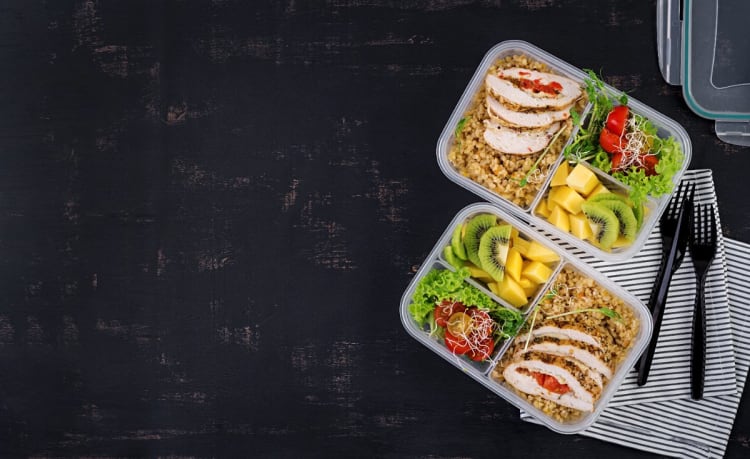
Gram measurements aren’t very helpful if you can’t estimate them. Rough guidelines: 100 grams of chicken breast provides about 23 grams of protein, 100 grams of low-fat quark about 12, one egg about 7, and 100 grams of cooked lentils about 9. For carbohydrates, 100 grams of cooked rice equals about 28 grams, and a slice of bread about 20. For fat, a tablespoon of oil equals about 14 grams, and a handful of nuts about 15.
The even distribution across meals that the calculator provides is a simplification—but a useful one when it comes to protein. Muscle protein synthesis responds to individual portions of about 25 to 40 grams; bundling everything into one meal is less effective than spreading it out over three or four portions. For carbohydrates and fat, however, the distribution throughout the day is largely irrelevant and can be based on your workout schedule.
The calorie expenditure calculator shows how much energy your workout actually burns and whether it’s worth adjusting your macronutrient distribution on workout days.
For Gyms: Macros in Consultations
Nutritional counseling in the strict sense is regulated in Germany and should be provided by qualified professionals. However, any fitness coach may provide general guidelines on macro distribution—and these are what members ask about most often.
In practice, it’s best not to start with all three macronutrients at once. The first step is almost always protein: a target amount in grams, spread out over meals—nothing else. Anyone who can stick to this for four weeks has reaped most of the benefits. Carbohydrates and fat can still be fine-tuned afterward.
Frequently Asked Questions / FAQ
Do I even need to track macros?
Not permanently. But tracking them for two to four weeks is instructive, because almost everyone overestimates their protein intake and underestimates their fat intake. After that, it’s usually enough to keep an eye on the protein portion per meal.
Does the protein guideline also apply if I’m overweight?
If you’re significantly overweight, calculating based on your total weight will result in very high amounts. In that case, it makes more sense to base your calculation on your target weight or lean body mass. As a rule of thumb: use the weight you’re realistically aiming for.
Are carbohydrates in the evening a problem?
No. It’s the daily balance that matters, not the time of day. If you sleep better at night or feel fuller when you consume some of your carbohydrates then, you should do exactly that.
What about fiber and alcohol?
Fiber is contained in carbohydrates; 30 grams per day is a good target. Alcohol doesn’t appear in any macronutrient breakdown, but it provides 7 kilocalories per gram and must be subtracted from your daily calorie total.
Do the macros change on non-training days?
Protein intake remains the same. If you’d like, you can cut back on carbs a bit on rest days and add some on hard training days. This isn’t mandatory—a consistent distribution throughout the week works just as well for most people and is much simpler.
Editorial team at fitnessmarkt.de
Image source: #7676366 timolina / freepik.com
Published on: 2 November 2026